
7 Best PPC Management Tools for 2026
Compare the best PPC management tools for agencies and in-house teams, with features, pricing signals, trade-offs, and use cases by team size.
- best PPC management tools
- PPC management software
- PPC automation tools
- agency PPC tools
- paid media platforms
The most popular advice about the best PPC management tools starts with the wrong question. There isn’t one universally best platform, because a team trying to pace budgets across client accounts has a different problem from a search team running structured ad tests or an enterprise managing retail media alongside paid social.
Start with the bottleneck. Do you need cross-network execution, search governance, rule-based automation, ad testing, budget pacing, or omnichannel coverage? This comparison assesses seven supplied platforms by supported channels, action depth, automation model, pricing signal, governance, and agency-size fit. It also separates read-only reporting from rule automation, budget control, and audited write actions, so a polished dashboard doesn’t get mistaken for a system that can safely change campaigns.
The category itself is moving toward software-led operations. The PPC management software market is estimated at $2.25 billion in 2025 and projected to reach $5.42 billion by 2034, with cloud deployment holding 75.8% of revenue share according to paid-search analytics market research. That growth makes tool selection more important, not less. The right platform should remove a specific operational constraint, while leaving room for native tools and specialist software where they already do the job well.
Table of Contents
- 1. AdCrunch
- 2. Search Ads 360
- 3. Skai
- 4. Optmyzr
- 5. Adalysis
- 6. Bïrch
- 7. Shape
- Top 7 PPC Management Tools Comparison
- Choose the Tool That Matches Your Operating Model
1. AdCrunch
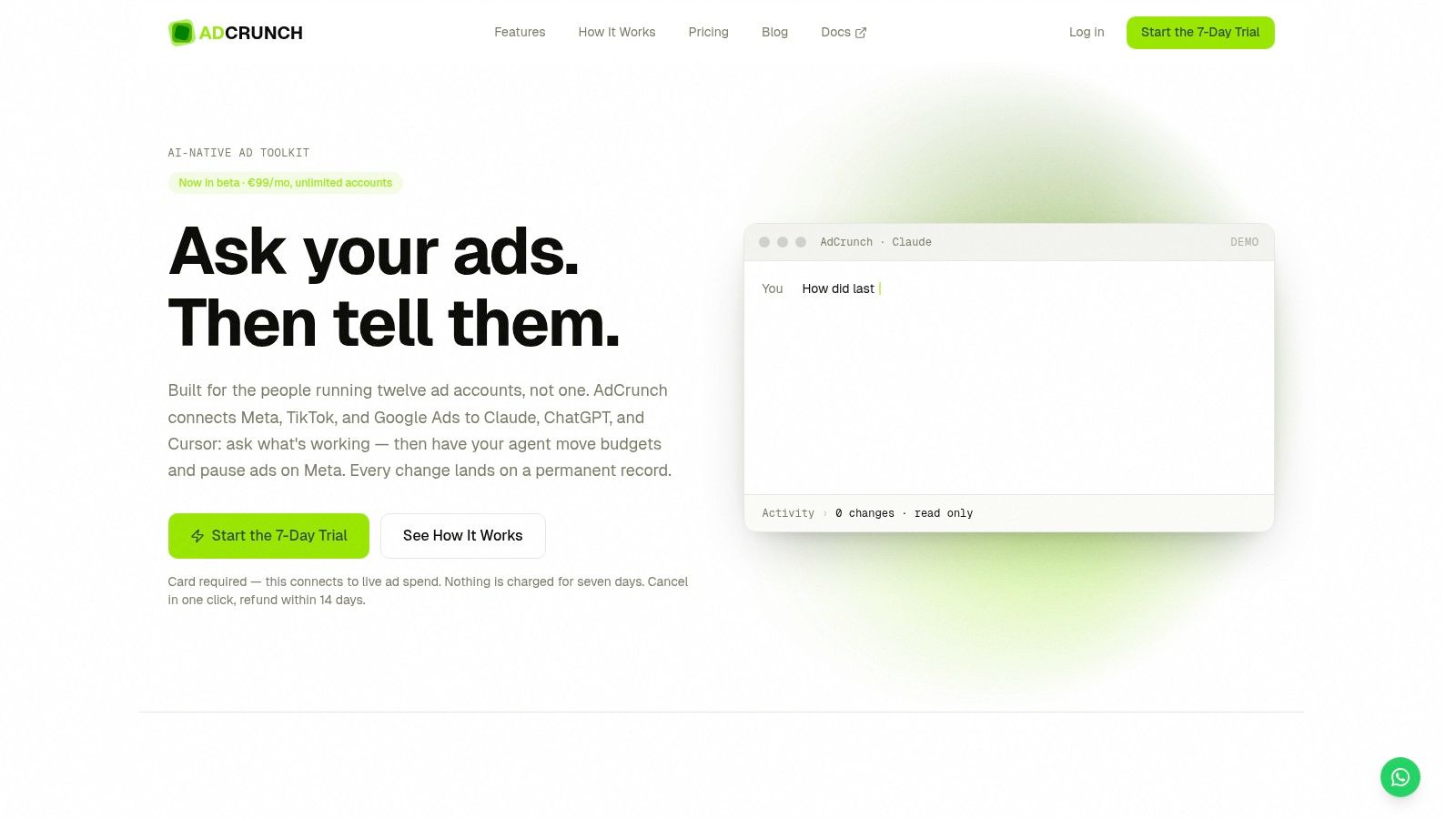
AdCrunch is most relevant when the operational problem is moving from diagnosis to a controlled campaign change. It connects Meta, TikTok, and Google Ads with Claude, ChatGPT, Cursor, and its in-console Adgent, giving teams one conversational layer across accounts. Meta supports write actions, while TikTok and Google Ads remain read-only.
That separation defines the product’s role. It is not a reporting dashboard or recommendation engine. AdCrunch can create Meta campaigns, ad sets, creatives, and ads; change daily or lifetime budgets; and pause, resume, or archive entities. New creations arrive paused. Hard deletes are unsupported, existing ad-set targeting cannot be edited, and bid changes are unavailable. The narrower write scope limits execution compared with a native console, while reducing the chance that an instruction immediately spends budget or removes campaign history.
Why agencies should examine the action layer
AdCrunch’s multi-account management workflow targets teams operating across many accounts rather than a single campaign. Skills & Brands let teams encode playbooks and brand rules. Campaign Plans provide structured instructions that the agent can execute. Together, these features create a path from request to action and review, instead of stopping at read-only reporting or rule-based recommendations.
The permanent Activity page records the account, exact change, request origin, and outcome. Credentials remain with AdCrunch, and calls run server-side rather than exposing access details to an external language model. For agencies and multi-brand in-house teams, that audit trail addresses a different need from visualization: verifying who requested a change, what happened, and whether it succeeded.
Operational test: If your team can identify a problem but still must open several ad consoles to fix it, prioritize write safety and traceability before adding another dashboard.
Trade-offs and fit
AdCrunch’s Pro plan costs €99 per month with unlimited ad accounts and seats. Enterprise adds SSO, SLA support, and custom integrations, according to the AdCrunch product site. A seven-day trial requires a card, and the product lists a fourteen-day refund policy.
The platform’s fit is clear. Meta is the only network with write capability today, so Google and TikTok changes still require native consoles. Flat pricing suits agencies, freelancers, and multi-account teams more than a single-account advertiser that only needs read-only reporting. Its value comes from controlled execution and account-level governance, not from replacing every network’s native tooling.
2. Search Ads 360
Search Ads 360 is built for enterprise search governance rather than lightweight campaign convenience. It brings Google Ads, Microsoft Advertising, and selected commerce media networks into a centralized workflow, which helps large teams coordinate engines without treating each console as a separate operating environment.
Its core strength is portfolio-level control. Bid strategies can be organized around shared objectives, while budget planning and pacing help teams monitor whether multiple campaigns are likely to stay aligned with planned spend. Cross-engine workflows, bulk edits, campaign creation, and centralized reporting are particularly useful when account structures span brands, markets, and search platforms.
Search Ads 360 also supports monitoring and reporting for Performance Max within its strategies. That Google alignment is a practical advantage for organizations already invested in the Google Marketing Platform ecosystem. Teams can keep conversion measurement, search management, and portfolio oversight closer together instead of creating disconnected operating rules.
Where governance outweighs simplicity
The best reason to choose SA360 is not access to more features. It’s the need to coordinate a large search program with controlled processes, shared budgets, and cross-engine visibility. A smaller agency may find those capabilities excessive, particularly if most work happens in Google Ads and the team doesn’t need formal portfolio governance.
The Google Marketing Platform Search Ads 360 overview is the right starting point for evaluating its enterprise positioning. Buyers should pay attention to implementation ownership, conversion setup, permissions, and how much of the daily workflow the team expects to move into the platform.
For teams researching the wider ecosystem, this guide to Google Ads tools offers useful context on how native and third-party workflows can coexist. SA360 is the better fit when orchestration and governance are the bottleneck, not when the priority is the fastest path to a few campaign edits.
3. Skai
Skai is the strongest choice for enterprise advertisers that need search, social, and retail media in one operating model. Its value comes from breadth across channels, not from being the simplest tool to learn. Teams can coordinate activation and measurement across paid search, paid social, and retail media while using algorithmic optimization for bids, budgets, and pacing.
Retail media is a major differentiator. Skai’s connection with Profitero SIM adds retailer, shelf, and competitive context to the platform’s wider campaign workflow. That makes it more relevant to commerce organizations that need advertising decisions tied to product visibility and retail conditions, rather than isolated search metrics.
A platform for coordination across media jobs
Skai also supports creative and bulk-management workflows for TikTok, Snap, and other social channels. Its practical role is to give enterprise teams a common place for pacing, optimization, activation, and reporting when media buying has expanded beyond search.
That makes Skai different from a specialist search testing platform. It isn’t primarily about n-gram analysis or tightly controlled RSA experiments. It is better suited to organizations that need to compare and manage several media environments at once, with retail media included in the same planning conversation.
The Skai platform is positioned for enterprise use, and that positioning brings real trade-offs. The interface, integrations, and operating model can require substantial implementation effort. Cost is also typically high for enterprise software, so the business case depends on meaningful cross-channel complexity rather than a desire to consolidate a few reports.
For a useful comparison of the wider category, see this analysis of PPC management tools. The key question is whether your team needs omnichannel activation and retail depth. If it does, Skai deserves a serious shortlist. If it doesn’t, its complexity may outweigh its coverage.
4. Optmyzr
Optmyzr is a strong agency platform for rule-based PPC automation, especially across Google and Microsoft accounts. Its Rule Engine lets practitioners create scheduled if/then workflows without building custom software, which gives experienced operators more control than generic recommendation dashboards.
The platform combines automation with audits, policy checks, URL checks, anomaly detection, PPC Investigator diagnostics, and Blueprints for repeatable processes. That combination is important for agencies because optimization isn’t one task. Teams need to find issues, decide what action follows, apply rules consistently, and monitor many accounts without losing the ability to intervene.
Configurable rules without custom coding
Optmyzr’s best use case is an agency or in-house team with established operating rules. A practitioner might define how the system should respond to a budget condition, an anomaly, or a recurring account hygiene issue, then schedule and monitor that workflow centrally. The value comes from translating team knowledge into repeatable operations.
Its feature cadence also extends utilities beyond its core Google and Microsoft focus, including newer support for Meta and LinkedIn. That broadens the platform’s usefulness, but buyers should still evaluate each channel by action depth rather than assuming every integration offers equivalent write capability.
Optmyzr’s official platform page provides the clearest route into its automation model. Pricing varies by ad spend, so the commercial fit changes as account portfolios grow. That spend-tiered structure can work well when the tool replaces substantial manual work across multiple clients, but it may be difficult to justify for low-volume or single-account advertisers.
Choose Optmyzr when your bottleneck is repeatable optimization logic at agency scale. Don’t choose it merely because it has a long feature list. The platform earns its place when your team is ready to define, maintain, and audit rules rather than relying only on one-off recommendations.
5. Adalysis
Adalysis is the specialist choice for search teams that care about disciplined testing and account hygiene. It focuses on Google Ads and Microsoft Ads, with tools for RSA testing, asset-level analysis, audits, budget tracking, projections, automation, and n-gram search-term analysis.
Its testing model is the main differentiator. Adalysis supports single-ad-group and multi-ad-group RSA tests, giving teams a more structured way to compare creative variations than replacing an ad and checking performance later. That matters when the objective is to learn which assets work, not just to find an account issue.
A better fit for search hygiene than omnichannel control
The platform also runs daily audits with more than one hundred customizable checks, according to the supplied product information. Those checks can surface technical and operational issues, while alerts help teams prioritize what deserves attention. N-gram analysis adds a search-term layer, helping practitioners inspect recurring word patterns associated with waste or opportunity.
All features are included on every plan, and the platform supports unlimited accounts and users. That simplifies procurement for agencies and removes some of the uncertainty created when essential capabilities are reserved for higher tiers.
The trade-off is narrow coverage. Adalysis isn’t designed for teams seeking unified social and retail execution across Meta, TikTok, and commerce media. Its strength is depth in Google and Microsoft search workflows, particularly when testing, query analysis, and hygiene are more urgent than cross-channel activation.
Visit Adalysis when your team wants a search operating layer with clear testing discipline. If your primary problem is moving budgets between social accounts or coordinating retail media, another platform will be a closer fit.
6. Bïrch
Bïrch, formerly Revealbot, is designed for paid-social automation and creative operations, with support across Meta, Google Ads, TikTok, and Snapchat. Its rule system can trigger budget changes, pause or resume campaigns, and scale connected accounts based on conditions defined by the team.
That makes Bïrch useful for operators who want fast, explicit guardrails. Rather than waiting for a weekly review, teams can configure rules around budget and performance conditions, then use alerts and workspaces to keep the operating picture visible. The platform also includes AI-assisted highlights, but its practical value still depends on whether the underlying rules reflect the team’s actual buying strategy.
Strong creative workflows for social teams
The Launcher is particularly relevant to paid-social teams producing and iterating many creative variations. It supports bulk uploading and creative workflows, with a strong emphasis on Meta. That separates Bïrch from tools centered primarily on search audits or enterprise retail-media planning.
Its external-assistant support through MCP can extend analysis and automation workflows for teams experimenting with AI-assisted operations. Buyers should still distinguish between analysis, automated rule execution, and unrestricted write access. Those are different control models, and a platform that automates a defined trigger isn’t the same as an agent that executes a natural-language request.
The Bïrch website presents a spend-tiered pricing model with annual discounts and trial availability. That structure can be accessible during early testing, but costs rise with connected ad spend. Agencies should model the pricing against client portfolios before standardizing on the platform.
Bïrch fits a paid-social agency or growth team whose bottlenecks are creative throughput, rule triggers, and fast budget control. It isn’t the obvious first choice for search-only teams or organizations that need extensive retail-media governance.
7. Shape
Shape is a specialist budget-management and pacing platform for teams that manage many accounts and campaigns. It centralizes spend data across Google, Microsoft, Meta, LinkedIn, TikTok, and other platforms, then uses Budget Pacer to forecast end-of-month totals and recommend target daily spending.
That focus gives Shape a clear job. It isn’t trying to replace every campaign console or become a universal creative workspace. It helps agencies and multi-account teams answer a more operational question: are campaigns on track to spend the intended budget, and what adjustment is needed to stay there?
Pacing depth comes with uneven action coverage
Shape’s API is useful for agencies building unified reporting or connecting PPC data to internal systems. Its data model and multi-platform ingestion can reduce the effort required to assemble a cross-account spend view, while one-way integrations extend reporting coverage where write actions aren’t available.
That limitation needs careful attention. Some channels, including TikTok in the supplied product description, support reporting without write-backs. Other integrations are also one-way. Shape can therefore provide excellent budget visibility without giving the team a universal mechanism for changing campaigns directly.
The Shape platform is best evaluated by listing the exact actions your team wants to automate. If the requirement is forecasting, pacing recommendations, and budget governance, Shape is purpose-built for the job. If the requirement is building ads, editing targeting, and executing changes across every connected network, it won’t provide equal action depth everywhere.
Top 7 PPC Management Tools Comparison
| Tool | Implementation 🔄 | Resources & Cost ⚡ | Expected outcomes ⭐ 📊 | Ideal use cases & tips 💡 | Key advantages |
|---|---|---|---|---|---|
| AdCrunch | Moderate, API integrations, server‑side credentials, safety guardrails; agent workflows | Low monthly flat fee (€99/mo); card required for write scope; cost‑efficient for multi‑account teams | Faster insight→action for Meta (write); unified cross‑network reporting; auditable change log | Agencies/freelancers/in‑house teams managing many accounts; use for quick budget/pauses and compliant write actions | Executes safe write actions, flat pricing, LLM connectors, permanent activity logs |
| Search Ads 360 | High, enterprise setup, Google Marketing Platform onboarding | High, geared to large spends and enterprise contracts | Granular portfolio bidding, cross‑engine pacing and centralized reporting | Large, high‑spend multi‑engine search programs; prefer when deep Google alignment needed | Robust portfolio bidding, strong Google product integration, enterprise governance |
| Skai (Kenshoo) | High, complex omnichannel integrations and advanced optimization | High, typical enterprise pricing and implementation effort | True omnichannel optimization, retail depth, cross‑channel pacing and algorithmic bids | Large advertisers needing unified search/social/retail workflows and shelf data | Unifies retail, social and search with advanced pacing and retailer integrations |
| Optmyzr | Moderate, configurable rule engine, Blueprints and diagnostics; low code | Variable, spend‑tiered pricing; scales for agencies managing many accounts | Powerful automations, audits and structured diagnostics to improve efficiency | Agencies with many Google/Microsoft accounts wanting custom automations | Highly configurable rules, PPC Investigator, frequent feature updates |
| Adalysis | Low–Moderate, focused setup for Google and Microsoft, straightforward rollout | Predictable, all features on every plan; unlimited accounts/users simplifies cost | Rigorous ad testing and audits, improved search account hygiene and forecasting | Search‑heavy accounts prioritizing RSA testing and daily audits | Comprehensive testing tools, unlimited accounts/users, simple procurement |
| Bïrch (Revealbot) | Low, fast setup for rule automations and bulk creative workflows | Variable, spend‑metered pricing that scales with ad spend | Rapid rule‑driven optimizations, bulk creative iterations, alerts and AI highlights | Paid social teams needing fast rule automation and creative bulk uploads | Fast rule automation, strong creative workflow support, clear pricing tiers |
| Shape | Moderate, focused on budget/pacing integrations and API access | Mid–High, agency‑friendly but some one‑way integrations limit actionability | Improved budget governance, forecasting and reduced overspend risk | Agencies managing many client budgets who need centralized pacing | Purpose‑built pacing, multi‑platform ingestion, API for integrations |
Choose the Tool That Matches Your Operating Model
Pick the tool by operational job, not by the number of features listed on its pricing page. The paid search tools market is estimated at $2.8 billion in 2025 and projected to reach $6.72 billion by 2033, with campaign-management tools holding 28.5% of the market, according to paid-search tools market data. That concentration reinforces a practical point: campaign orchestration remains a core buying need, but orchestration can mean very different things across search, social, retail, and agency operations.
Start by separating four layers. Read-only reporting helps a team understand performance. Rule-based automation applies predefined conditions. Budget governance monitors pacing and planned spend. Audited write actions change campaigns, budgets, or status inside an advertising platform. A buyer who needs the fourth layer shouldn’t select a tool based only on the first.
For a multi-account team seeking an AI-assisted workflow that moves from diagnosis to controlled Meta actions, AdCrunch is the clearest fit. Its permanent Activity log, paused creations, restricted write scope, unified Meta, TikTok, and Google view, and €99 per month flat Pro pricing make it especially relevant to agencies and multi-brand teams that want predictable access without per-account or per-seat expansion.
Use Search Ads 360 for governance-heavy search programs across Google and Microsoft. Choose Skai when search, paid social, and retail media need one enterprise operating model. Optmyzr is the better agency automation specialist for configurable rules and centralized account monitoring. Adalysis fits search teams focused on testing, audits, and query hygiene. Bïrch suits paid-social teams managing rules, budgets, and creative variations. Shape is the specialist for pacing and spend governance.
Your final evaluation should answer these questions:
- Network coverage: Which platforms does the tool connect to, and are those connections read-only or writable?
- Action depth: Can it report, recommend, automate rules, or execute audited changes?
- Safeguards: Are creations paused, deletions restricted, and permissions controlled?
- Pricing basis: Is cost tied to seats, accounts, ad spend, or a flat organization plan?
- Scale limits: Can the account and seat model support your agency or multi-brand structure?
- Implementation ownership: Who maintains rules, integrations, conversion data, and approval processes?
- Automation target: Which exact actions should the system perform, such as pacing, pausing, testing, or budget changes?
A broader marketing stack may also include project management and reporting tools, but those systems shouldn’t be confused with ad operations platforms. The strongest setup may combine native Google and Meta tools with one specialist layer, especially for smaller teams that don’t need an all-in-one suite. Market-level user data points to an unresolved workflow problem, with paid search advertising software scoring 5.8 out of 10 for workflow capability, compared with 8.5 out of 10 for the category average in that subdimension, as reported in category satisfaction research. That gap is where operational design matters most.
AdCrunch gives multi-account teams one AI-assisted workflow for querying Meta, TikTok, and Google Ads, while supporting controlled Meta campaign actions with a permanent activity record. Visit AdCrunch to see whether its guarded write operations and flat €99 per month Pro plan fit the way your team manages PPC.